Why we blend with Turkey Tail
17 July 2026 · 4 min read
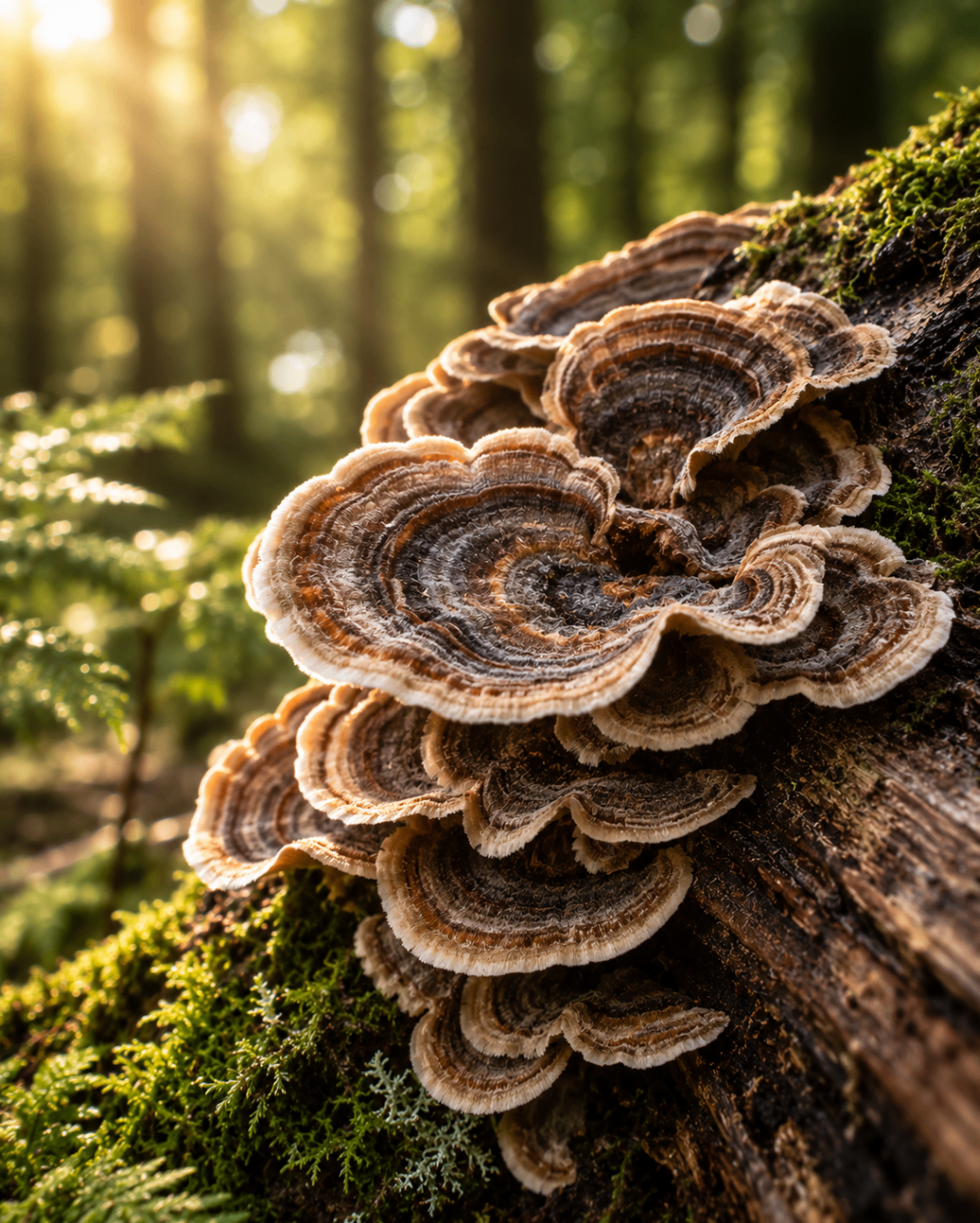
The fan-shaped mushroom of the forest floor — striped, unassuming, and one of the most studied of the immune-supportive mushrooms.
Walk any temperate woodland after rain and you will almost certainly find Turkey Tail. It grows in overlapping fans on fallen logs and dying wood — small, striped, and — as its name suggests — remarkably like the tail feathers of a wild turkey. Its Latin name, Trametes versicolor, means 'of many colours': a nod to the concentric bands of brown, cream, russet and grey that make each specimen slightly different.
The most studied of the medicinal mushrooms
Turkey Tail is arguably the most heavily researched of the functional mushrooms. Two of its extracts — PSK in Japan and PSP in China — have been the subject of decades of clinical study in the context of immune support. In both countries it is used within mainstream medicine.
A long tradition, quietly
In East Asian traditional practice, Turkey Tail was simply a daily immune tea — Yun Zhi in Chinese, Kawaratake in Japanese. It was drunk not as a rare tonic but as a steady, unremarkable part of the seasonal shift into cold weather.
Reserved for what comes next
Turkey Tail is not yet in a current Grann Rising blend. We're taking the time to source it from the growers who meet our standards for cultivation, extraction, and traceability — and it is being reserved for a future PURE-family release. It's in the library now so the picture of the functional mushroom world is complete.
How it is traditionally used
- Historically brewed as a long, gentle tea.
- One of the most studied medicinal mushrooms in the world.
- Used across the cold seasons rather than as an acute remedy.
- Planned for a future PURE-family blend.