Why we blend with Schisandra Berry
22 July 2026 · 5 min read
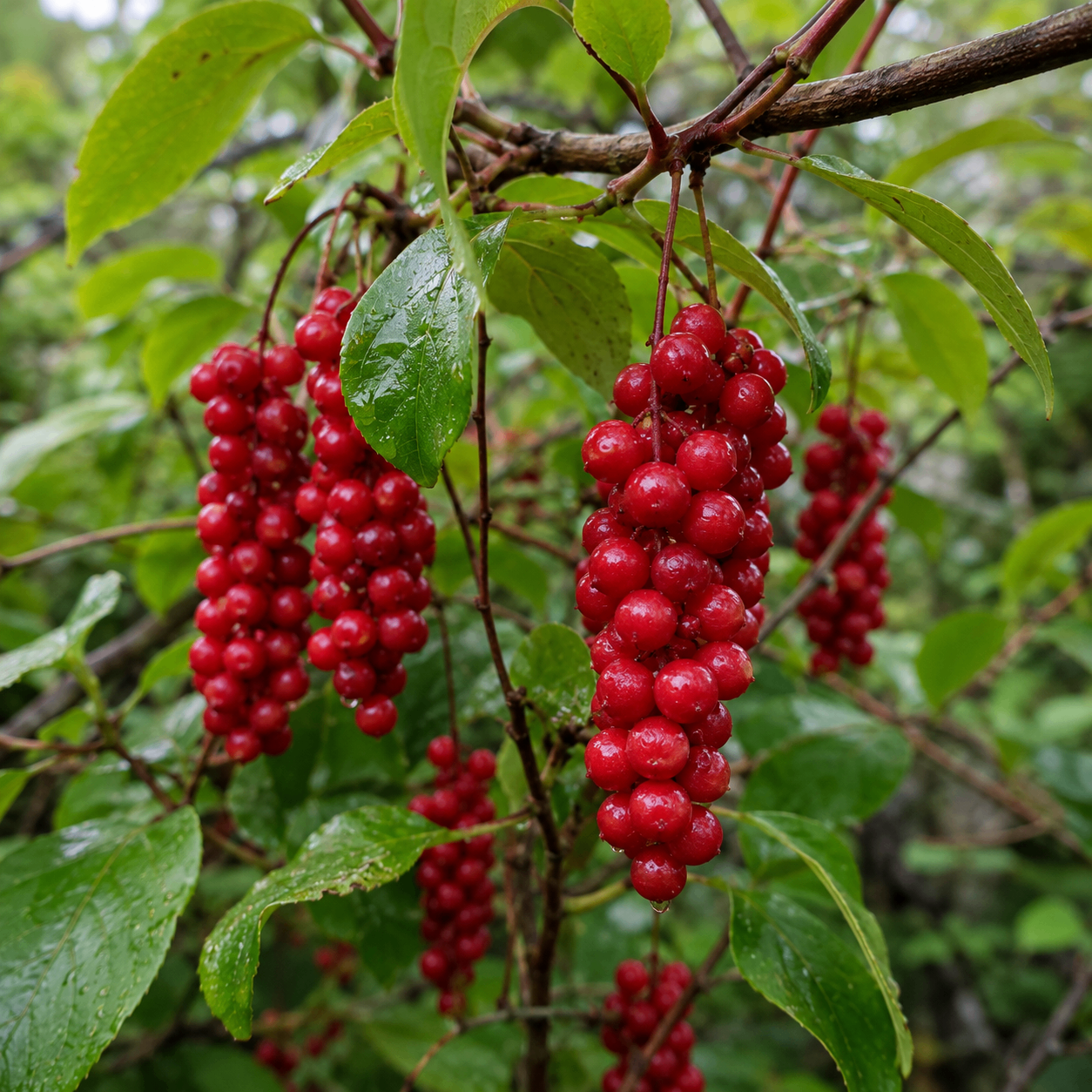
The 'five-flavour berry' — a small adaptogenic fruit of quiet resilience.
Schisandra chinensis is a small, vivid red berry native to the temperate forests of north-east China, Korea and the Russian Far East. Its Chinese name — Wu Wei Zi — translates as 'five-flavour berry', a reference to the extraordinary fact that a single Schisandra fruit carries all five classical flavours at once: sweet, sour, bitter, salty and pungent. In traditional herbalism, that alone is a rarity worth noting.
A tonic of Jing
In Chinese traditional practice, Schisandra is classified as a Jing tonic — a long-term botanical for the body's deep reserves rather than a quick fix for the day. It was traditionally used to support the liver, the kidneys, and the settled endurance that carries a person through long seasons of work.
In the twentieth century, Russian researchers picked up the tradition — Schisandra was studied and used by Soviet athletes, pilots and long-distance workers as a botanical for endurance and mental clarity under strain.
Why it sits in RISE
RISE is built around steadier mornings — not a burst, but a slow, resilient opening into the day. Schisandra is one of the botanicals that gives it that quality. It sits beside Albizia for gentle uplift and Asparagus Root for grounding, with the mushrooms carrying the clarity.
How we take it
- Supports steady energy without stimulation.
- Traditionally used as a long-term tonic, not a quick fix.
- One of the few botanicals to carry all five classical flavours.
- Pairs with Albizia and Asparagus Root in RISE.