Why we blend with Asparagus Root
24 July 2026 · 5 min read
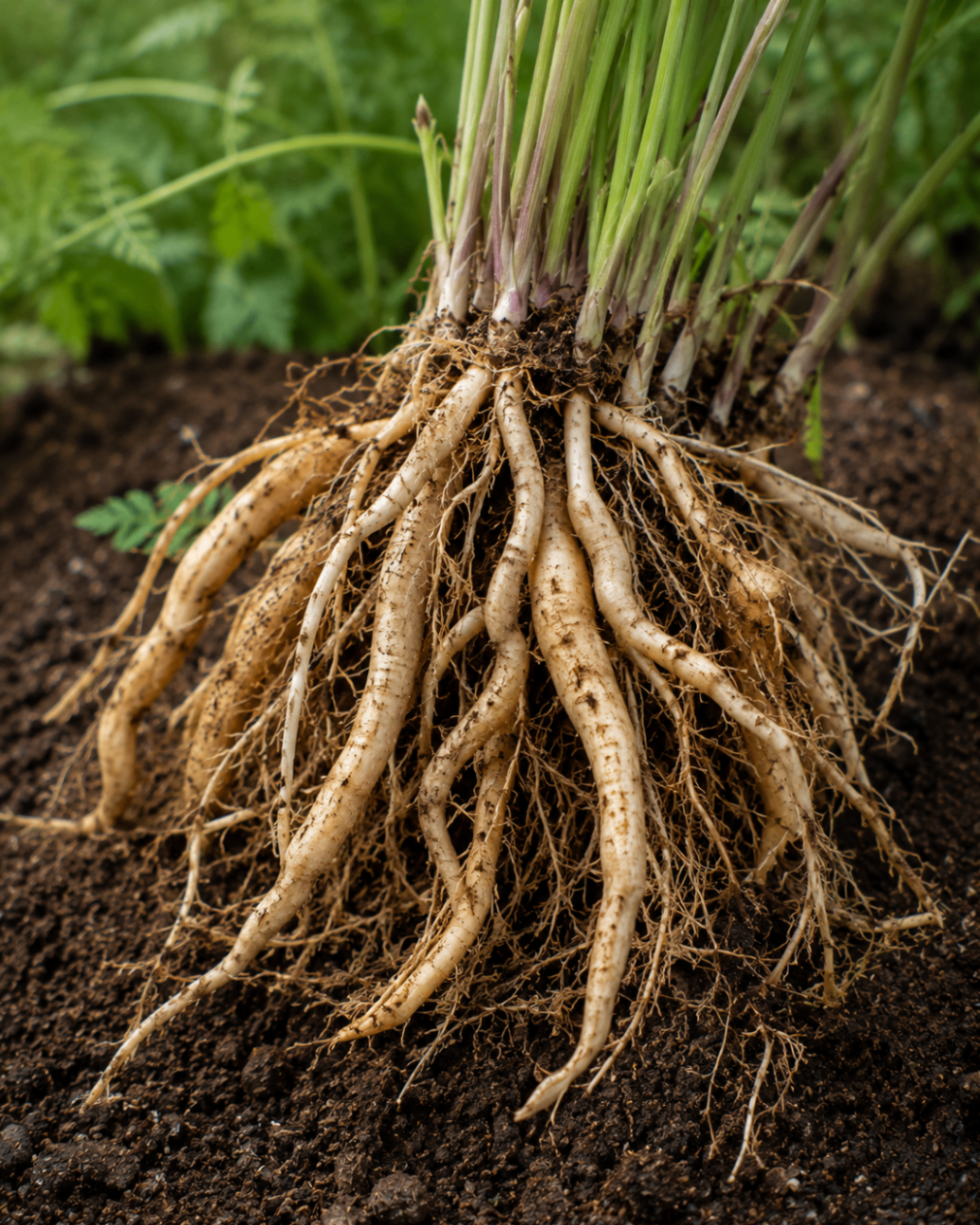
A grounding, mineral-rich root of Ayurvedic tradition — the quiet base note of steadier mornings.
Asparagus racemosus — Shatavari — is a climbing plant native to India, Sri Lanka and the Himalayas. Its roots are the medicinal part, harvested from mature plants and traditionally dried, powdered and prepared in warm milk or ghee. It is a distant relative of the edible garden asparagus but is not the same plant and is not eaten in the same way.
One of the great Ayurvedic tonics
The Sanskrit name Shatavari has been variously translated — most poetically as 'she who possesses a hundred roots', or in some readings, 'she who has a hundred husbands' — a reference to its traditional use as a rejuvenating tonic across the whole of adult life. In classical Ayurveda it is one of the most highly regarded rasayanas: a long-term botanical for grounding, nourishment and quiet balance.
The role of a base note
In a blend, some botanicals lift and some ground. Asparagus Root grounds. It is mineral-rich and gently cooling — the note that keeps the more uplifting botanicals in RISE from tipping into stimulation. Without a grounding note, a morning ritual is only a stimulant. With one, it becomes a ritual.
Why it sits in RISE
RISE is where our most complete botanical arrangement lives: mushrooms for the mind, Schisandra and Albizia for uplift and openness, and Asparagus Root as the base note that holds all of it steady.
How we take it
- A different species from the edible garden asparagus.
- Traditionally taken over long periods, not in short courses.
- Prepared in classical Ayurveda with warm milk or ghee.
- Grounds the more uplifting notes in RISE.